Introduction: An earthquake changes how we see Panama
On October 9, 2026, Panama was shaken by an exceptionally strong earthquake. According to SINAPROC, Panama's civil protection agency, it reached a magnitude of 7.5. The epicenter was located about 39 kilometers northwest of Tonosí, near the border between the provinces of Los Santos and Veraguas. The focal depth was only about four kilometers.
The earthquake was felt across large parts of Panama, including in the capital, Panama City, about 200 kilometers away. Tremors were even registered in the neighboring countries of Costa Rica and Colombia. Numerous aftershocks followed, including further very strong tremors. On October 10, the government declared a national state of emergency.
The event raises questions that go far beyond the immediate damage.
Is Panama still a safe country for expats? Can you still buy property here with a clear conscience? And how high are the risks for people who want to invest a substantial part of their wealth in Panamanian real estate?
These questions are by no means theoretical. In recent years, Panama has developed into an attractive location for international expats, wealthy individuals and real estate investors. In Panama City in particular, modern residential high-rises, luxury apartment complexes and large new construction projects shape the cityscape.
Anyone who buys a condominium here often invests several hundred thousand dollars, and for larger apartments or penthouses well over a million.
The earthquake of October 9 forces us to take a closer look at a risk factor that may not always receive the attention it deserves in real estate decisions.
Why I waited to write this article
I experienced the earthquake myself.
My wife and I live on the eleventh floor of a modern residential high-rise in Costa del Este, one of the upscale neighborhoods of Panama City.
When the earthquake began, I was sitting at my computer in a video conference. Suddenly the floor beneath my feet began to move. Within a few moments the shaking became so violent that I had to hold on to my desk. I still remember exactly how I called out to the ongoing video conference: “¡Muy fuerte, muy fuerte!” – very strong, very strong!
Then everything happened very quickly. I stood up, threw something on, slipped into my shoes and left the computer running. Everything else stayed where it was. Within a few seconds, my wife and I decided to leave the building immediately.
I would not rule out that in moments like these one can speak of mortal fear. The entire high-rise was swaying, the floor was moving, and we had no idea what would happen next. Was this already the peak of the earthquake? Or would it get even stronger? Could the building possibly collapse?
We hurried down the stairwell from the eleventh floor to the lobby. Numerous other residents were in the stairwell, apparently having made the same decision.
Whether it was right to head straight for the stairwell while the shaking was still going on is another question. General safety recommendations usually advise first taking cover inside the building during an earthquake, for example under a sturdy table, and only going outside via the stairs once the shaking has stopped. But in that moment, you do not think about theoretical rules of conduct. The urge to get out of the swaying high-rise as quickly as possible was overwhelming.
When we were finally outside, we still did not feel safe by any means. We moved roughly 100 to 200 meters away from the building and looked for a spot from which we could keep watching the high-rise. The thought that it might topple over in another quake was constantly on our minds. That is why we wanted to keep enough distance. Waiting right in front of the entrance or in the lobby was out of the question for us.
We spent the next two to two and a half hours outside, including a walk through Costa del Este. Only once the situation had calmed down somewhat did we find the courage to return to our apartment.
Above all, we wanted to find out whether there was any damage. As we left the apartment, I had heard a clattering sound; perhaps a glass or another object had fallen over. In our haste, we had not been able to see any major damage.
So we went back up and entered our apartment.
But we had not even been there for a minute when a strong aftershock struck.
Immediately the building began to sway again. The fear we had only just overcome was instantly back. We fled the apartment and once again hurried down the eleven floors through the stairwell.
When we were outside again, we were above all relieved to have made it once more.
This time it took much longer before we were allowed to enter the building again. We stayed outside the building for more than seven hours, mostly in places where we assumed there was as little danger as possible from collapsing buildings or falling building parts.
In the meantime, I tried to find out about the likelihood of further severe aftershocks. Among other things, I asked ChatGPT how great the risk was that an even stronger earthquake could follow such a strong one.
The answer I received was an order of magnitude of about five percent.
This figure weighed on me considerably. At first, five percent does not sound like very much. But when you have just experienced a high-rise swaying heavily, you think differently about it. For me, the figure above all meant that an even stronger earthquake was by no means ruled out. And I could not assess what such an event would have meant for our building.
After the long hours outside, we finally went back into our apartment. We hoped that the worst was now over.
But this hope did not last long either.
I was already in bed when distinct tremors set in again. Once again the building moved. Once again the fear was immediately back.
This time we decided not to stay in the high-rise any longer. We packed the bare essentials, also took blankets with us and went to our car. We then drove to an open area where we could keep as much distance from buildings as possible.
We spent the night there in the car.
Restful sleep was out of the question. Again and again we thought we felt the vehicle moving and wondered whether another aftershock was taking place. The uncertainty would not let us rest.
In the following days, a large number of aftershocks were reported. Most of them were not noticeable or barely noticeable for us, but some were clearly felt. The thought that we could be caught off guard by a stronger tremor at any moment remained.
The next day, the service provider we had hired to rent out our new apartment suggested that we use the apartment ourselves for the time being. It was not yet fully furnished, but he had everything necessary prepared in no time, so that we could move in. In this stressful situation, it was a great stroke of luck to have such a flexible and helpful partner at our side.
We only went briefly to our apartment in Costa del Este to pack up our most important personal belongings.
We then moved for a few days into our new apartment in Panamá Pacífico, which had actually been intended for rental. There, in the much smaller building and on a much lower floor, we felt much more comfortable and were gradually able to calm down somewhat.
Only after a few days did we return to our apartment in Costa del Este.
This experience has changed our attitude toward living in a high-rise. For my wife in particular, the thought of another severe earthquake has since been associated with considerable fear.
And I, too, who try to look at the situation rather rationally, now ask myself questions that I had not dealt with this intensely before October 9.
It is not only about whether a modern high-rise could collapse in an earthquake. It is just as much about what damage a building can suffer, what financial consequences result from it and how reliably these risks can be assessed at all.
This personal experience is one of the reasons why I have looked into the topic in depth.
Although I was directly affected, I deliberately refrained from publishing an article right away. Because already in the first days after the earthquake, two different perspectives began to emerge.
Both are justified.
And both lead to different conclusions for people considering emigrating to Panama or buying property there.
Two theses: Test passed or risk underestimated?
Thesis 1: Panama has passed the test
The earthquake can certainly be seen as evidence of the resilience of modern Panamanian buildings.
Although the earthquake was exceptionally strong and was felt in large parts of the country, according to the reports available so far there was no series of collapsed modern residential high-rises in Panama City.
That is an important and encouraging finding.
The capital, with its numerous high-rises, apparently withstood the shaking comparatively well. Modern buildings are constructed according to technical regulations that also take earthquake loads into account.
Shortly after the earthquake, the Panamanian press therefore already discussed whether the resilience of the buildings was a success of engineering and building regulations.
This view is by no means unfounded.
Anyone designing a modern high-rise must take into account that a building is exposed to horizontal forces during an earthquake. A certain amount of movement is not automatically a sign of a lack of stability. On the contrary: the ability of a structure to deform in a controlled way and absorb energy in the process is one of the essential principles of earthquake-resistant construction.
From this perspective, one could conclude that Panama has, on the whole, come through a major natural disaster better than one might initially have feared given the magnitude.
However, one crucial limitation must be taken into account: the epicenter was not in Panama City.
Thesis 2: The real test may still be ahead
A second perspective arrives at a more cautious assessment.
The earthquake was indeed clearly felt in the capital. However, the strongest ground motions occurred in other regions, especially near the epicenter.
The fact that modern high-rises in Panama City did not collapse one after another therefore does not yet prove how the same buildings would respond to a comparably strong earthquake directly beneath the capital.
There is also a second aspect that is at least as important from a real estate investor's point of view.
A building can survive an earthquake without collapsing and still suffer considerable damage.
Cracks in walls, damaged pipes, deformed façade elements, and damage to elevators or technical systems can cause considerable repair costs.
It would be even more serious if load-bearing components were affected.
A distinction must be made between different types of damage. A visible crack in the plaster is not in itself proof of structural damage. Conversely, the integrity of a building cannot be inferred solely from the fact that no major cracks are visible from the outside.
The crucial question is therefore not only whether a building is still standing.
The question is also what technical and economic condition it is in after the earthquake.
And it is precisely at this point that a much more complex risk assessment begins for property buyers and owners.
What actually happened: The preliminary damage assessment
Fortunately, the number of reported injuries remained comparatively low. According to SINAPROC's assessment of October 19, 27 people were injured and one person died: a woman who later succumbed to her injuries. Behind these numbers are individual lives and stories. They must therefore not obscure how much suffering the earthquake and the aftershocks have brought to the people in the affected regions. Many lost their homes or had to spend the night outdoors or in tents for a time. On top of this came worries about the drinking water supply, financial losses and the constant fear of further tremors.
By October 19, the Instituto de Geociencias of the Universidad de Panamá had already counted 917 aftershocks, so almost a thousand. Most of them we could not feel at all here in Panama City. Some, however, were clearly noticeable for us as well.
The first days after the earthquake were marked by a constantly changing news situation.
On October 14, SINAPROC already reported 4,045 affected families and 879 families who had completely lost their apartments or houses. In addition, there were numerous buildings with moderate, partial or minor damage.
On October 19, the civil protection agency published a further interim assessment. By the previous evening, 8,920 apartments and houses had been inspected. In addition, damage to 619 educational facilities and 42 health facilities had been registered. (See also: SINAPROC interim assessment of October 19, 2026.)
These figures make clear that the earthquake had considerable consequences, even if the damage in Panama City was less dramatic than in the more severely affected provinces.
| 7.5 | Magnitude of the main earthquake |
| 8,920 | Apartments and houses inspected |
| 619 | Affected educational facilities |
Preliminary figures from SINAPROC as of October 19, 2026. The number of apartments and houses inspected is not the same as the number of damaged properties.
Public infrastructure was also affected. Roads, bridges, hospitals and government buildings had to be inspected and in some cases closed.
Following damage to its own facilities, the Caja de Seguro Social also declared an institutional state of emergency in order to speed up repairs and insurance procedures. (See also: La Prensa on the institutional state of emergency of the Caja de Seguro Social.)
It is still too early for a final assessment of the economic consequences.
The number of reported damage cases may rise as inspections progress. At the same time, some initial suspected cases may be classified as non-critical after expert assessment.
Especially with larger buildings, it can take time until all relevant structural components and technical installations have been adequately inspected.
How great is the earthquake risk in Panama really?
Panama lies in a tectonically complex region of Central America.
Several large tectonic plates and smaller tectonic structures interact here. They include the Caribbean Plate, the Nazca Plate, the Cocos Plate and the South American Plate.
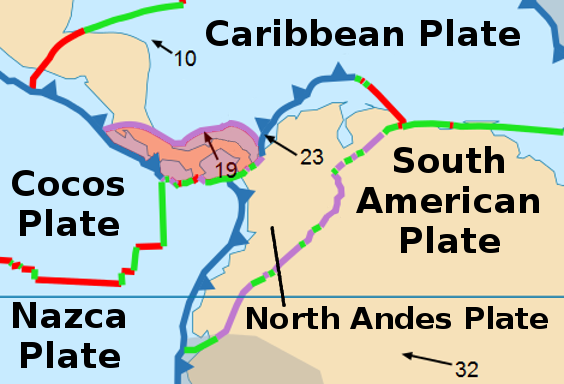
Source: “PanamaPlate.png” by Alataristarion, Wikimedia Commons, derived from “Tectonic plates boundaries detailed-en.svg” by Eric Gaba (data: Peter Bird; background: NGDC World Coast Line). License: CC BY-SA 4.0. Reproduced without changes.
The movements of these plates cause stresses in the Earth's crust. When these stresses are suddenly released along a geological fault, an earthquake can occur.
However, the seismic hazard is not equally high everywhere in Panama.
There are regions with significantly stronger historical earthquake activity and others where major earthquakes have been observed comparatively rarely.
Panama City is not one of the regions where strong earthquakes occur regularly. However, this does not mean that the capital is geologically free of hazard.
There are active faults near Panama City, too
A particularly interesting scientific study comes from Thomas Rockwell and other researchers. It was published in 2010 in the Bulletin of the Seismological Society of America.
Under the title Neotectonics and Paleoseismology of the Limón and Pedro Miguel Faults in Panamá: Earthquake Hazard to the Panamá Canal, the scientists examined, among other things, the Limón and Pedro Miguel faults in central Panama.
The results show that these faults have caused considerable ground displacements in the past.
Particularly noteworthy is the Pedro Miguel fault, which is associated with the historic earthquake of May 2, 1621. At that time, parts of old Panama were severely damaged.
The scientific studies show that the fault zones are geologically active and are in principle capable of producing stronger earthquakes as well. (See also: Study on the Limón and Pedro Miguel faults.)
The study is particularly recommended for interested readers because it is based on geological field observations, investigations of past ground displacements and scientific dating.
A further article published by La Prensa on October 19, 2026 explicitly addresses the Pedro Miguel fault. The newspaper emphasizes that the recent earthquake should by no means be interpreted as an indication of an imminent activation of this fault. (See also: La Prensa on the Pedro Miguel fault.)
This is an important distinction.
A geologically active fault does not mean that a severe earthquake will inevitably occur there in the foreseeable future.
Nor does a long period without major tremors mean that a fault has become harmless.
According to current scientific knowledge, earthquakes cannot be reliably predicted, either in terms of their exact timing or their location and strength.
What does this mean for Panama City and Panamá Pacífico?
For Panama City and the development areas to the west, including Panamá Pacífico, a differentiated assessment is therefore necessary.
The distance from known fault zones is an important factor. But it is not the only one.
Equally relevant are the local soil conditions, the nature of the geological layers and the question of how seismic waves can propagate and be amplified at a specific location.
A scientifically mapped fault should therefore not be confused with a precisely defined hazard line.
For a real estate decision, what matters is how the seismic hazard at the specific property is assessed.
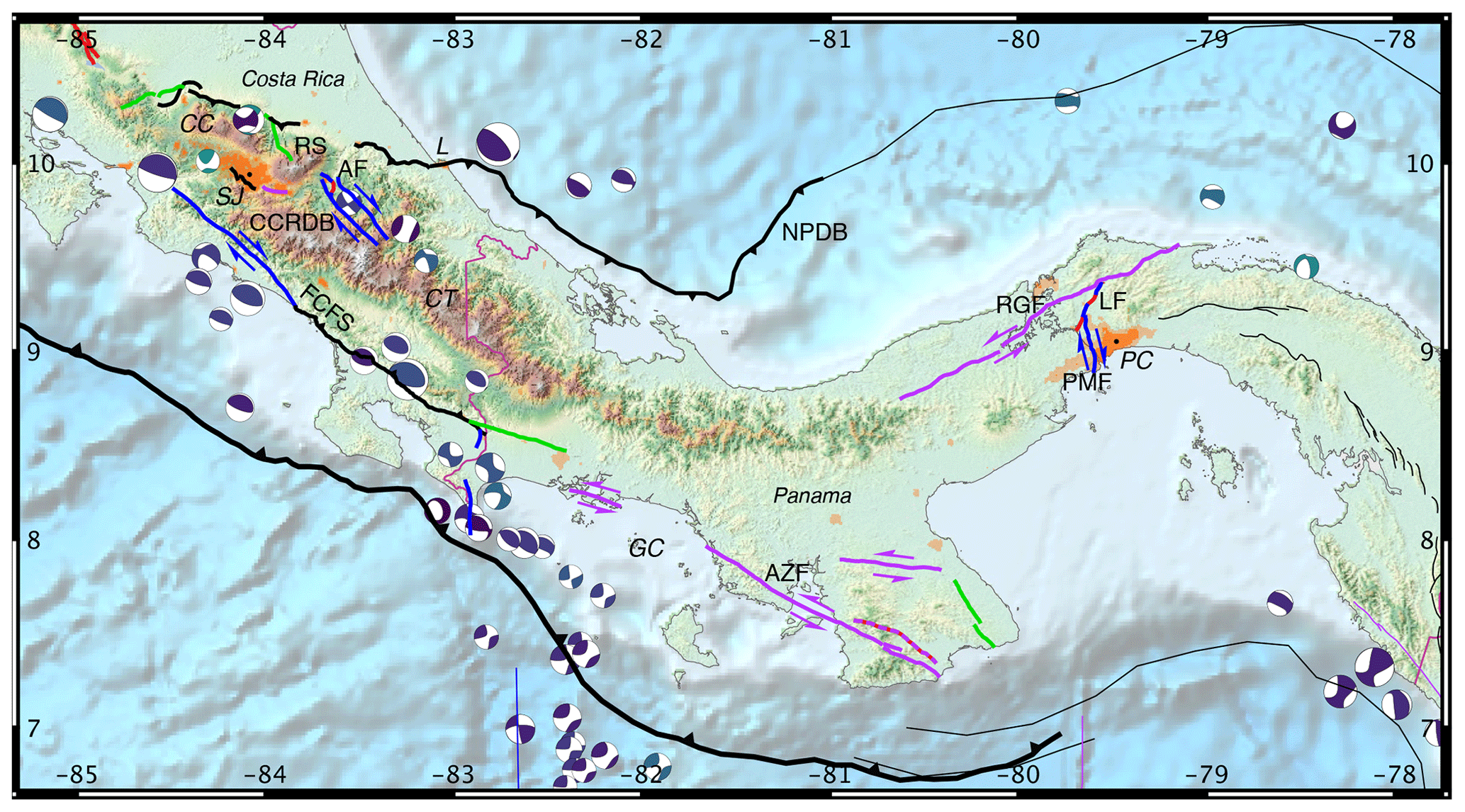
Source: R. Styron, J. García-Pelaez, M. Pagani: “CCAF-DB: the Caribbean and Central American active fault database”, Natural Hazards and Earth System Sciences 20, 831–857, 2020, Fig. 6, https://doi.org/10.5194/nhess-20-831-2020. Settlement areas based on data © WorldPop (according to the original publication). License: CC BY 4.0. Reproduced without changes.
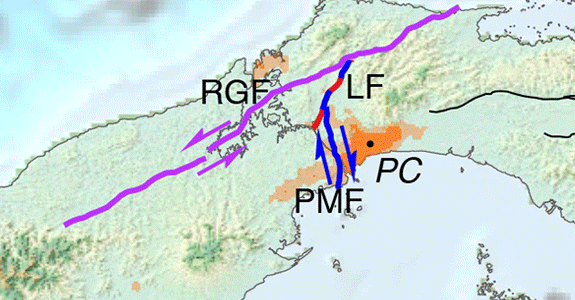
Source: as above (CCAF-DB, Styron, García-Pelaez and Pagani 2020, Fig. 6, https://doi.org/10.5194/nhess-20-831-2020). License: CC BY 4.0. Change: cropped to the Panama City area, otherwise unchanged.
An often underestimated factor: The ground
When assessing earthquake safety, attention is often focused on the design of the building.
However, the ground beneath it can be at least as important.
A building on solid rock may respond differently to seismic shaking than a comparable building on soft sediments or artificially filled land.
Soft soil layers can amplify certain vibrations. Under unfavorable conditions, water-saturated, loose soils can also partially lose their bearing capacity. This phenomenon is known as soil liquefaction.
However, one must not draw the sweeping conclusion that every building on filled land is dangerous.
What matters are the specific soil conditions, the compaction, the building's foundation and the engineering measures taken into account during design and construction.
The strategic development plan of the District of Panama explicitly addresses the seismic hazard. Among other things, it names areas of filled land in Costa del Este, Punta Pacífica, Marbella and Punta Paitilla as areas whose soil conditions deserve particular attention in a risk assessment. (See also: Strategic Development Plan of the District of Panama, Annex 1 (PDF).)
This has an important consequence for property buyers:
It is not the location of a property alone that determines its safety, but the combination of ground, foundation, structural design and actual construction.
Anyone planning a larger investment should therefore not only ask about the year of construction and the developer, but also, where appropriate, about the geotechnical report and the structural basis of the building.
How safe are modern high-rises in Panama?
Panama City has a large number of modern residential high-rises. Particularly in Costa del Este, Punta Pacífica, Avenida Balboa and other upscale neighborhoods, buildings with several dozen floors are commonplace.
This form of housing has considerable advantages.
Modern apartment complexes often offer security staff, controlled access, parking spaces, swimming pools, fitness areas, communal facilities and a high level of living comfort.
I described these advantages in detail in my book about emigrating to Panama. For many expats, especially retirees, such residential complexes can be an extremely attractive solution.
The earthquake has not canceled out these advantages.
But it has raised an additional question: How do such buildings behave during strong seismic shaking?
Why high-rises are allowed to sway
A common misconception is to interpret every movement of a high-rise as a sign of a lack of stability.
In fact, earthquake-resistant structures are designed so that they can absorb certain movements and deformations.
A completely rigid building would not necessarily be safer.
The challenge for structural design is to absorb the forces occurring during an earthquake in a controlled manner and to prevent dangerous failure mechanisms.
The primary aim is to protect human life.
However, this does not mean that every earthquake-resistant building must remain completely undamaged after a strong earthquake.
Here, a distinction must be made between two different protection goals:
Life safety: The building should prevent collapse or sufficiently limit the probability of life-threatening structural failure.
Damage limitation: The building and its technical installations should suffer as little economic damage as possible and remain usable after the event.
These two goals are not identical.
A building can meet the life safety requirements and still be damaged so severely that extensive repairs are necessary.
For a resident, the first question is decisive. For an owner and investor, both are of great importance.
New construction does not automatically mean risk-free
Differences can exist even among modern buildings.
The year of construction, the technical regulations in force at the time, the quality of the design, the construction work, the materials used and the supervision of the work all play a role.
Added to this are changes over the course of the building's service life.
Alterations, interventions in load-bearing components, inadequate maintenance or existing damage can change the assessment of a building.
A prudent property buyer should therefore not only pay attention to the outward appearance, the fittings or the name of the developer.
What matters is the actual technical quality of the property.
The real problem for real estate investors: Who bears the costs?
In my view, this is one of the most important aspects of the entire discussion.
If a modern high-rise survives an earthquake and no one is injured, that is very good news to begin with.
For the owner of an apartment, however, the matter is not yet settled.
Let us take a simplified example.
A residential high-rise with 100 condominium units suffers earthquake damage to technical installations, façades and common building components.
The repairs cost a total of two million US dollars.
If these costs had to be borne entirely by the owners and were distributed evenly on a purely arithmetical basis, this would result in a burden of 20,000 US dollars per apartment.
In practice, the costs might be allocated according to ownership shares and taking into account existing reserves, insurance and other arrangements.
Nevertheless, the example shows how quickly seemingly manageable building damage can become a considerable financial burden.
In the case of more extensive structural damage, the costs can be significantly higher still.
The risk of common building components
When you own a condominium, you do not only own your apartment. You are also financially tied to the common building.
This includes, for example, the load-bearing structure, façades, roof areas, elevators, central pipes, technical supply installations and other common areas.
Damage to these areas can affect all owners, regardless of whether their own apartment shows visible damage.
This is a fundamental difference from a single-family home.
With a detached house, the risks also exist, but responsibility for inspection, repair and insurance usually lies more directly with the owner.
With a high-rise, on the other hand, you are additionally dependent on decisions by the owners' association, the management, insurers and possibly numerous other parties.
What does this mean for resale value?
Another consideration is the ability to sell the property later.
How does the real estate market react when a building shows damage after an earthquake, even if this damage can be repaired?
Will buyers demand a price discount?
How does an unresolved damage situation affect bank financing?
And what are the consequences if repairs drag on for months or years?
These questions cannot be answered across the board at present.
But they should be part of an economic risk assessment.
After all, a real estate investment consists not only of the purchase price and ongoing income. Possible extraordinary repair costs and limitations on marketability are also part of the overall picture.
Why a simple visual inspection is not always enough
After the earthquake, numerous property management companies and owners began inspecting buildings for visible damage.
This is necessary and sensible.
An initial visual inspection can identify obvious damage and indicate whether further investigations are required.
However, it does not automatically replace a comprehensive technical assessment.
Especially in larger buildings, investigations of load-bearing components, connections, foundations and technical installations may become necessary.
A distinction must be made between:
- superficial cracks in plaster and cladding,
- damage to non-load-bearing walls and façade elements,
- damage to pipes and technical installations,
- possible damage to load-bearing components,
- changes in the ground or the foundation.
Which investigations are required must be decided in each specific case by a suitably qualified specialist engineer.
We are now experiencing for ourselves how difficult it can be to organize such an assessment. After the fact, we discovered minor cracks in our apartment and informed the property management in writing. It replied that it was not responsible for cracks inside our apartment, only for the hallways and common areas. We were told to hire qualified professionals ourselves to assess the cracks in our apartment.
The reply contained no specific contacts, no information on possible costs and no offer to help us organize an inspection. We felt rebuffed and largely left alone with our concern. Of course, this does not tell us whether the cracks are merely superficial or need to be investigated further.
For me, this experience is also part of evaluating a real estate investment in Panama: Alongside construction quality and insurance coverage, the cooperation with the property management plays an important role. How accessible, helpful and transparent it is can make a considerable difference in everyday life and especially after such an event.
For buyers of a resale condominium, this creates an additional challenge.
An apartment can appear flawless, while damage still exists in the common property or extensive repairs are planned.
That is why one should not rely solely on viewing the apartment before buying.
Also important are the technical documents for the entire building, known damage reports, existing expert reports, resolutions of the owners' association and possible financial obligations.
Insurance: An area with a considerable need for clarification
A particularly difficult topic is insurance against earthquake damage. I too have looked into it more closely since the earthquake.
We recently took out insurance for two condominiums. The annual premiums are around 100 US dollars each. At first glance, this seems extremely inexpensive.
However, a low premium by no means indicates that comprehensive insurance coverage exists. What matters are the risks actually insured, the sum insured, the deductibles and the numerous terms, conditions and exclusions. In my case, it remains to be clarified in particular which building components are insured at all and to what extent the insurance covers damage to common property.
What does the Panamanian insurance industry say?
On October 12, 2026, the newspaper La Prensa published an article in which the Asociación Panameña de Aseguradores (APADEA) explains which types of insurance can in principle cover earthquake damage. (See also: La Prensa on insurance for earthquake damage.)
A distinction is made between different forms of insurance, in particular between fire insurance with corresponding earthquake coverage and more comprehensive multi-risk insurance. What matters is whether the earthquake risk is actually part of the contract.
For condominium owners, further questions arise. Is there building insurance for the entire residential high-rise? Which parts of the common property are insured? How high is the sum insured in relation to the actual reconstruction costs?
Which deductibles apply in the event of an earthquake? Who bears the costs if the sum insured is insufficient? And what rights do individual owners have if the property management does not provide sufficient information about the existing insurance coverage?
Especially for high-priced properties, these questions are of considerable economic importance. Buying an apartment for 500,000 or one million US dollars without knowing the main financial risks of a severe earthquake does not, in any case, seem sensible to me.
A personal consequence: Our planned property purchase
The earthquake has also influenced our own investment decisions. We had already been looking intensively into buying a larger penthouse in a high-end apartment complex.
The decision had not been entirely easy even before. There were many arguments in favor of the purchase, but also some against it. Nevertheless, we were prepared to pursue the project further and have a comprehensive technical inspection carried out.
Then came the earthquake.
After that, the situation looked different to us. On the one hand, after this experience my wife no longer wants to live in a high-rise in the long term. On the other hand, the technical and financial risks of such an investment came more to the fore for me.
This is expressly not a claim that the building in question is unsafe. Rather, it became clear how difficult it can be for a buyer to reliably assess the actual condition of a larger building after a strong earthquake.
What damage is already known? What investigations have been carried out? What repairs will be necessary? And what costs could the owners face in the future?
As long as these questions have not been sufficiently clarified, the economic risk can only be assessed to a limited extent. We therefore decided not to pursue the planned purchase any further.
This does not mean that we no longer want to buy property in Panama in principle. On the contrary: We continue to look intensively into real estate investments and are now increasingly considering land and single-family homes as well.
But our priorities have changed. The location, the quality of the ground, the possibility of earthquake-resistant construction and the financial manageability of possible damage have become more important to us.
Is a single-family home the better alternative?
This question is an obvious one. A detached single-story house can offer certain advantages over a large high-rise.
The building structure is often easier to oversee. Inspections and repairs can be organized more directly. There is no dependence on a large owners' association.
The psychological strain can also be lower. Someone who lives in a single-story house during an earthquake may experience the situation differently from someone on the thirtieth floor of a swaying high-rise.
However, this does not mean that a single-family home is fundamentally safer. A house, too, can stand on unsuitable ground, be poorly designed or be poorly built.
Careful investigations are required especially for plots with fill, a high groundwater level, slopes or problematic drainage. A single-story building on unsuitable ground can, under certain circumstances, cause greater problems than a professionally designed high-rise on a suitable foundation.
The crucial question is therefore not: high-rise or single-family home? But rather: Which specific property, taking all relevant factors into account, offers a reasonable balance between safety, quality of living, costs and risk?
Should you still emigrate to Panama now?
This brings us back to the first of the two initial questions. Is Panama still a suitable country to emigrate to after the earthquake?
In my view, it would be wrong to base the entire decision about emigrating on a single natural event. Panama continues to offer numerous features that make the country attractive to international expats.
These include the tropical climate, the use of the US dollar, the international connections, medical care in Panama City, the comparatively modern infrastructure of certain residential areas, the various options for obtaining legal residency status, the personal freedom to shape one's own life and a diverse society with people of different backgrounds and ways of life.
However, Panama's suitability depends heavily on the personal requirements one has for one's future place of residence. In my book, I therefore paid particular attention to places to live that, in my view, are suitable for financially independent expats. It is not only beautiful landscapes or low living costs that play a role.
At least as important are medical care, infrastructure, accessibility, safety, shopping facilities, an overall reliable residential environment as well as cultural offerings and the opportunity to get to know the country and its people and to take part in social life.
According to the information available so far, the locations I presented were not at the immediate center of the most severe damage from the October 9 earthquake. Of course, this is no proof that these locations will be spared from severe earthquakes in the future. But it does show that a careful choice of location makes sense for a variety of reasons.
Anyone who decides to emigrate should consider not only a country's advantages, but also its natural, economic and social risks. Earthquakes are undoubtedly one of them in Panama. The question is how to deal with this risk.
Why millions of people still live in Panama City
There is one more thought I find interesting in this context. A great many people live and work in Panama City. Numerous families, entrepreneurs, international professionals and wealthy individuals consciously choose to live in modern residential high-rises.
High-quality apartment complexes also continue to be built and sold. One could conclude from this that these people know the risks and evidently consider them acceptable. Perhaps this even reflects a kind of collective experience: over many years, people make decisions in favor of certain locations because they have proven themselves in everyday life.
However, this is no scientific proof of the safety of a location. The fact that many people take a certain risk does not automatically mean that it is small.
People take numerous factors into account in their decisions. Some may know the geological risks very well, others less so. And even decades without major damage can be deceptive.
Nevertheless, this aspect should not be ignored entirely. It is no coincidence that Panama City has become one of the most important economic centers in Central America. The city has a long history of development and has seen considerable investment in its infrastructure.
The October 2026 earthquake does not fundamentally call this development into question. But it does give reason to take certain risks into account more consciously in future decisions.
Outlook: More transparency instead of false security
The question of whether Panama remains an attractive destination for expats and real estate investors after the severe earthquake cannot be answered with a simple yes or no. Both perspectives presented in this article are justified.
One can regard Panama City's comparatively mild experience of the earthquake as a positive sign of the quality of modern construction. But one can equally point out that the epicenter was far away from the capital and that the financial consequences of possible building damage can so far only be partially foreseen.
Which conclusion one draws from this depends largely on one's personal willingness to take risks. This article cannot make a decision for or against Panama for anyone. However, the earthquake has highlighted some areas in which improvements would be desirable.
1. More transparency regarding insurance coverage
Property buyers should be able to reliably determine before purchasing which earthquake damage is insured and which financial burdens remain in the worst case. This includes understandable insurance terms, comprehensible deductibles and a clear distinction between the insurance of individual apartments and that of the common building. It would also be welcome if such insurance products became easier to compare and more understandable for foreign owners.
2. Reliable building inspections and expert reports
After a severe earthquake, owners and potential buyers must be able to obtain reliable information about the technical condition of a building. A purely visual inspection is not sufficient in every case.
What would be important are comprehensible expert reports, clear documentation of identified damage and transparent information about planned repairs and possible financial obligations. Especially for larger condominium complexes, better documentation could contribute considerably to investment security.
3. An effective earthquake early warning system
A modern early warning system would be another sensible step. Such systems cannot predict earthquakes. However, they detect earthquakes that have already begun and, under favorable conditions, can issue a warning before the strongest shaking reaches a location farther away.
Depending on the distance from the epicenter, valuable seconds can be gained in this way. In the case of an earthquake directly beneath a city, on the other hand, there may be hardly any warning time. Besides its practical benefits, a reliable system could also improve many residents' subjective sense of security.
4. Better communication with owners and residents
Communication between property managers, insurers, experts, authorities and owners could also be improved. After an earthquake, those affected above all need reliable information.
Which inspections have been carried out? What results are available? Are there restrictions on the use of the building? What further inspections are planned?
Such questions should be answered promptly and comprehensibly. In an internationally oriented country like Panama in particular, it would also make sense to provide important information in English as well. Modern digital communication and translation technologies offer good conditions for this today.
5. The discussion has already begun
The call for more transparency and better controls is by no means just a personal consideration. In Panama itself, there has been intense discussion since the earthquake about construction quality, government oversight and the resilience of infrastructure.
For example, in an opinion piece for La Prensa on October 12, 2026, geologist Omar Sugasti called for a critical examination in particular of the quality of public works, materials testing and the supervision of construction projects. (See also: Opinion piece by Omar Sugasti in La Prensa.)
Other experts, too, see a need for improvement in the practical implementation of the technical regulations that are in principle in place. This is an important discussion.
Because for Panama's long-term attractiveness as a place to live and invest, it is not enough for modern building regulations to exist. What matters is that they are applied consistently and that buyers and owners can reliably assess the quality of their properties.
A residual risk always remains
There is no such thing as absolute safety. Not in Panama, and not anywhere else. Everyone lives with risks, whether in road traffic, in their own home or in everyday activities.
Earthquakes are among these risks in Panama. When and where the next severe earthquake will occur cannot be reliably predicted. Even a statistically low probability can have serious consequences for the individual.
Added to this is a personal dimension that cannot be captured by statistics and technical reports alone. Anyone who has experienced a strong earthquake in a swaying high-rise may view living at great heights differently.
My wife, for example, has been affected by this experience much more than I have. Such fears cannot simply be dispelled by pointing to modern building regulations or statistical probabilities. Whether they will subside over time remains to be seen.
Perhaps this is the most important lesson from this earthquake: We cannot prevent natural hazards, nor can we fully predict them. But we can ensure that their possible consequences become better known, better covered and thus more consciously calculable for each individual.
That would be a gain for Panama – regardless of whether one ultimately decides for or against emigrating or investing in real estate.
Sources and further reading
The following selection includes official publications, scientific studies and recent articles from the Panamanian press. Some of the newspaper articles are opinion pieces and should be understood as such.
Official sources and scientific studies
1. SINAPROC – Damage assessment of October 19, 2026. Official information on inspected buildings, affected facilities and relief measures.
Official statement
2. SINAPROC – Comunicado Oficial No. 12, October 14, 2026. Interim assessment of affected families, damaged homes and regional damage.
Official statement
3. Organización Panamericana de la Salud (OPS/OMS), October 2026. Situation report on the earthquake and its impact on health care.
Situation report (PDF)
4. Rockwell, T. K. et al. (2010). Neotectonics and Paleoseismology of the Limón and Pedro Miguel Faults in Panamá: Earthquake Hazard to the Panamá Canal. Bulletin of the Seismological Society of America, 100(6), 3097–3129.
Original scientific publication
5. Municipio de Panamá – Plan Estratégico Distrital, Anexo 1 (2021). Includes, among other things, discussions of the seismic hazard and of problematic soil conditions in Panama City.
Planning document (PDF)
6. Consejo de Gabinete – Resolución de Gabinete N.º 108 of October 10, 2026. Declaration of a national state of emergency following the earthquakes of October 9, 2026. Published in Gaceta Oficial N.º 30631 of October 10, 2026, Article 1, page 3.
https://www.gacetaoficial.gob.pa/storage/gacetas/2026/10/30631/105696.pdf#page=3
Panamanian press and expert opinions
7. La Prensa, October 10, 2026: Terremoto en Panamá: lo que revela sobre la seguridad de los edificios.
Read article
8. La Prensa, October 10, 2026: ¿Por qué no se pueden comparar los terremotos de Venezuela y Panamá? Explanations by engineers on soil conditions, construction methods and earthquake damage.
Read article
9. La Prensa, October 11, 2026: Terremoto en Panamá: el secreto de las edificaciones, las normas sísmicas y la falla de San Andrés.
Read article
10. La Prensa, October 12, 2026: El terremoto que también debe sacudir a nuestras instituciones. Opinion piece by Omar Sugasti.
Read opinion piece
11. La Prensa, October 12, 2026: Qué cubre el seguro y cómo documentar los daños por el terremoto.
Read article
12. La Prensa, October 16, 2026: Edificios anteriores a 1984: cuáles son, qué riesgos enfrentan y cómo reforzarlos.
Read article
13. La Prensa, October 19, 2026: Lo que debes saber de la falla de Pedro Miguel.
Read article
14. La Prensa, August 10, 2026: El próximo terremoto también será financiero. Opinion piece by Joaquín Riesen on the possible financial consequences of earthquake damage for property owners.
Read opinion piece
15. Panamá América, October 13, 2026: Familias quieren volver a sus hogares, pero tienen miedo. Report by Vivian Jiménez on families who, for fear of further earthquakes, spend the night outdoors, in tents or on mats in parks and parking lots.
Read article
16. La Estrella de Panamá, October 14, 2026: Elena Barría, primera víctima fatal por el terremoto de 7,5 en Panamá. Report by Leiny Pérez on the 68-year-old woman from Macaracas who was injured by a collapsing house wall during the earthquake and later died of her injuries.
Read article
17. La Prensa, October 19, 2026: Panamá registra 917 réplicas tras el terremoto de Azuero; también sismos en Chiriquí y Bocas del Toro. Count by the Instituto de Geociencias of the Universidad de Panamá as of October 19: 917 automatically detected aftershocks, 411 of which had been reviewed by staff.
Read article