Panama as a Possible New Place to Live
For many people, Panama is initially associated with the Panama Canal, a tropical climate, beaches, and an internationally oriented capital. Anyone considering living in the country permanently should carefully weigh the advantages and disadvantages. It is equally important to determine whether their expectations, financial resources, and personal circumstances are compatible with local conditions.
This section is therefore neither a conventional travel guide nor a complete description of the country. Its purpose is to assess Panama as a possible place to live and make a home, combining objective information with personal experiences and observations from everyday life.
Panama at a Glance
Panama lies between North and South America and connects the Atlantic and Pacific Oceans. The country is relatively small, but there are significant regional differences. Panama City is a modern, internationally oriented metropolis, while other parts of the country are considerably quieter, more rural, and in some cases only partially developed.
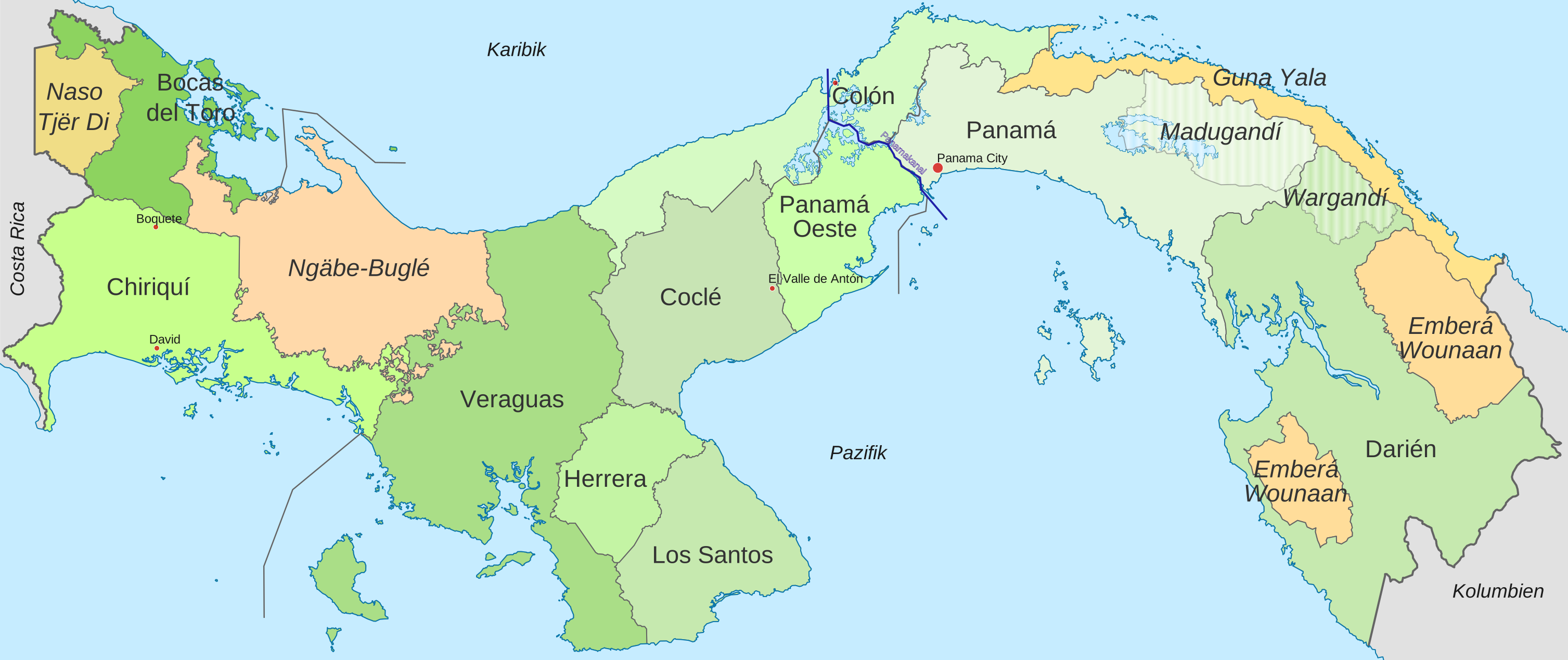
The official language is Spanish. English is also used to some extent in international business and in certain residential areas. However, Spanish language skills are a considerable advantage in everyday life, when dealing with government offices, service providers, or medical facilities.
The U.S. dollar is used alongside the balboa. Both currencies are valued at a one-to-one exchange rate and are used interchangeably in everyday transactions. This simplifies many financial matters and provides a degree of transparency. At the same time, Panama is not a typical low-cost country, although it is often perceived that way. Actual living expenses depend on factors such as housing standards, lifestyle, and personal expectations, but they are frequently higher than many prospective emigrants initially assume.
Reasons Panama May Be Attractive
Panama may be especially attractive to people who appreciate a tropical climate, an international environment, and comparatively well-developed infrastructure. Panama City offers modern residential developments, shopping malls, private hospitals, restaurants, and a wide range of services.
Compared with many cities in Germany, Panama City appears surprisingly modern and international in many respects. At the same time, some procedures and structures may seem less automated and standardized from a German perspective. This contrast is one of the defining characteristics of the city.
Panama also offers diverse natural landscapes, coastlines on two oceans, and short travel distances between the city, rainforest, mountains, and beaches. Depending on one's preferred lifestyle, its geographic position between North and South America may also be attractive.
For some emigrants, Panama's territorial tax system, use of the U.S. dollar, and various residency options are additional factors. These aspects should always be evaluated in relation to the individual's circumstances and, where appropriate, with professional advice.
Factors That Should Not Be Underestimated
The year-round warm climate is not equally comfortable for everyone. High temperatures and often high humidity are part of everyday life. However, with a lifestyle adapted to the climate—for example, through air-conditioned homes, vehicles, and stores—it can be very comfortable. Many people therefore find the humidity less burdensome in daily life than they initially expected.
The rainy season also differs from what many people imagine. It does not mean that it rains continuously for days. Instead, sunny or lightly overcast periods usually alternate with showers or thunderstorms of limited duration. Although these occur more frequently than during the dry season, they generally cause only minor disruption to daily life. The increased cloud cover also regularly provides welcome shade and is considered pleasant by many people.
Bureaucratic procedures sometimes take longer than expected and do not always function as predictably as people may be accustomed to in Germany. Patience, flexibility, and a willingness to adapt to different ways of working are therefore helpful.
The quality of roads, public facilities, and services can also vary considerably by region.
Healthcare should likewise be assessed carefully. Panama City has modern private hospitals and medical specialists. Outside the capital, the range of services may be significantly more limited. Health insurance, place of residence, and personal medical needs should therefore always be considered together.
Many of these challenges can be reduced considerably by choosing the right location, an appropriate housing situation, and having sufficient financial resources. This is precisely why the available budget plays a greater role in deciding for or against Panama than many prospective residents initially assume.
Panama Is Not the Same Everywhere
Whether Panama is suitable as a new place to live depends largely on where in the country a person intends to settle. Panama City offers comfort, services, and international contacts, but it also has heavy traffic, dense development, and high costs in many areas.
Coastal communities and rural regions offer a quieter lifestyle and closer access to nature. At the same time, shopping, healthcare, internet access, road quality, and public infrastructure may not be comparable to those in the capital.
General statements about life in Panama are therefore only of limited value. Region, neighborhood, type of housing, and personal lifestyle often influence people's experiences more strongly than the country itself.
Personal Experiences and Observations
Our own experiences relate mainly to Panama City and, in particular, Costa del Este. Many impressions differ from the expectations we had before emigrating. Some concerns have become less significant in everyday life, while other differences only became apparent gradually.
We experience a modern, well-served, and internationally oriented everyday life. At the same time, it repeatedly becomes clear that many things are organized differently than in Germany. Some processes are straightforward, while others require more patience, flexibility, and willingness to adapt.
These observations reflect personal experiences and should not be understood as universally applicable assessments. Other regions, housing arrangements, and personal circumstances may lead to very different impressions.
Assessing Panama Realistically
Panama can be an attractive place to live and make a home. The decisive question, however, is not whether the country is generally considered good or bad, but whether it fits the individual's priorities.
Climate, language, residency law, costs, healthcare, security, infrastructure, and everyday life should therefore not be considered in isolation, but as interconnected factors. An extended stay before making a final decision can help compare expectations with reality.
More Detailed Information in the Book
The book Emigrating Using Panama as an Example examines life in Panama in detail and places many topics within the broader decision-making and emigration process. The website serves as a companion information platform, presenting selected topics, an initial overview, supplementary downloads, and future updates.